

Cotton Swab Manufacturing Process & Production Knowledge
Date: 11/17/2026 2:19:00 PM Click: 4
What is cotton swab manufacturing? Cotton swab manufacturing is an integrated industrial sequence that converts cotton sliver and stick materials into finished swabs through fiber opening, cotton head forming, adhesive attachment, drying, inspection, and packaging. On modern equipment, these stages collapse into a continuous flow: stick feeding → cotton winding → drying → counting → packaging.
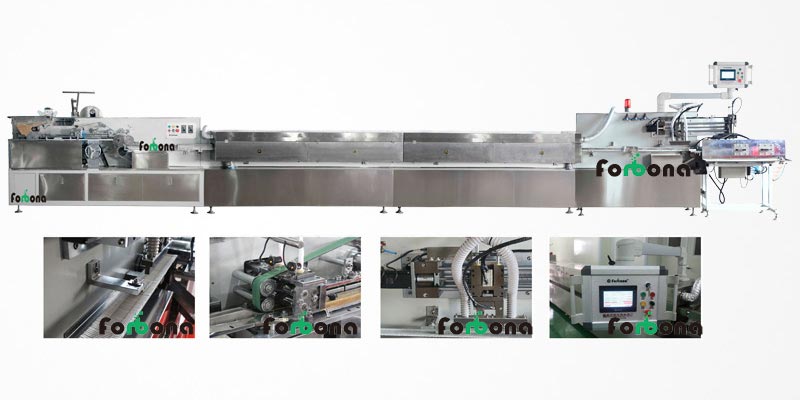
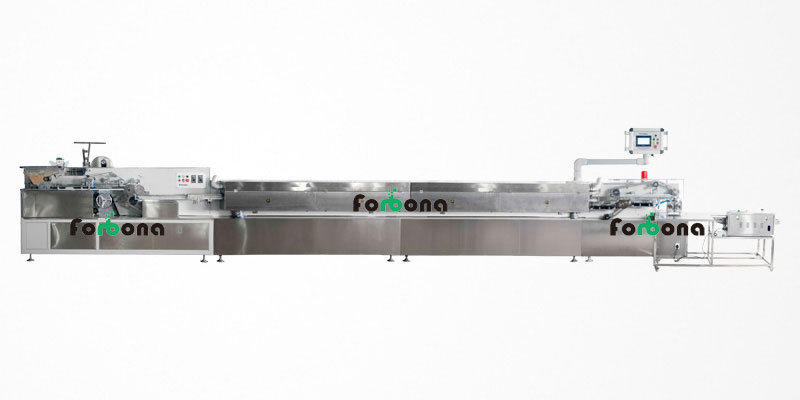
What are the main production stages? Six stages define the process: raw material preparation, cotton fiber opening, cotton head forming and attachment, swab assembly (winding plus drying), inspection and quality control, and counting and packaging. In a one-step finishing machine, stages three through six occur inside a single coupled system—the FBN-01, for example, integrates the main cotton swab unit, oven, and packaging table into one device.
What equipment is required? The irreducible equipment set is a cotton swab making machine and a packaging unit. If sticks are produced in-house rather than purchased, a plastic or paper stick making machine enters upstream. For medical-grade output, the drying section must be a closed-type oven with humidity control at near-zero levels, and the forming section must be rated for heavier sliver—the FBN-1200MS runs 4 g/m sliver through a closed drying oven and complies with Class II medical device requirements.
What factors affect production efficiency? Four variables dominate: sliver weight consistency, stick dimensional accuracy, adhesive delivery stability at the winding head, and synchronization between winding speed and packaging throughput. At 1200 pcs/min winding output, packaging becomes the bottleneck unless the counting and bagging interface is calibrated to match.
What Are Cotton Swabs Made Of?
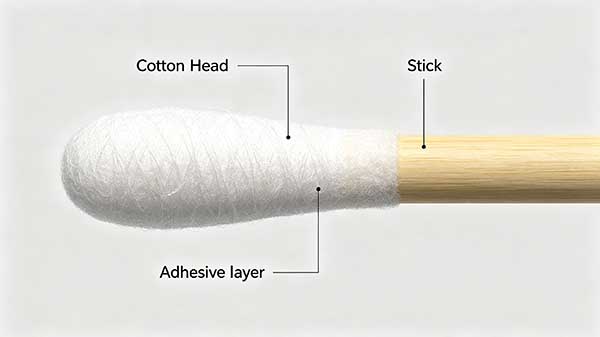
A cotton swab is a two-component product: the cotton head and the stick. Everything else—adhesive, packaging film—is auxiliary.
Cotton head. The head is formed from cotton sliver, a continuous band of opened and aligned fibers. Standard hygiene and cosmetic swabs use 1.5 gsm sliver on FBN-01 and FBN-01S-class machines. Medical swabs use heavier sliver: the FBN-1200MS is rated for 4 g/m sliver to achieve the denser tip required for clinical use. Adhesive is applied to the stick tip before winding; without adequate glue coverage at the nozzle, the head will not anchor through the drying sequence.
Stick. Four materials are in commercial rotation: plastic, paper, wood, and bamboo. The FBN-01 is rated for all four, with a standard stick window of 70 mm (±2 mm) length, 2.0–2.5 mm diameter, and 1.6–2.5 g weight. The FBN-1200MS accepts longer medical sticks—80 mm, 100 mm, and 120 mm—at 2.3–2.5 mm diameter. If plastic sticks are produced in-house rather than purchased, a plastic stick making machine becomes part of the upstream material preparation stage.
Auxiliary materials. Adhesive and packaging film complete the material set. Medical packaging must additionally satisfy hygiene barrier requirements.
Overview of the Cotton Swab Manufacturing Process
The process follows a fixed logic: prepare → open → form → assemble → verify → pack. The practical difference between equipment tiers is how tightly these stages are coupled.
Raw Material Preparation
Preparation covers incoming inspection and staging of sliver, sticks, adhesive, and packaging consumables. Two failure modes originate here. First, sliver stored in humid conditions clumps and disrupts feeding, producing uneven head formation downstream. Second, sticks loaded outside the machine’s rated length or diameter window misalign at the winding station and can jam the feed track. The pre-operation checklist on an integrated line therefore verifies adhesive levels and glue nozzle patency before power-on—starting with a clogged nozzle produces defective swabs from the first batch.
Cotton Fiber Opening and Processing
Raw cotton is opened, carded, and aligned into a continuous sliver suitable for winding. On integrated machines, this function is built into the feed section: fibers are carded, shaped, and delivered to the winding station in a controlled stream. Sliver weight consistency is the controlling output parameter. Running 4 g/m medical sliver on a machine rated for 1.5 gsm, or vice versa, will not produce acceptable heads regardless of other adjustments.
Cotton Head Forming and Attachment
This is the precision step. The stick enters the winding station, adhesive is applied to the tip(s), and a measured portion of sliver is wrapped and shaped around the coated end. Four synchronized variables govern quality: sliver feed tension, stick alignment, adhesive application (volume and nozzle condition), and roller/guide condition. On the FBN-1200MS, the roller design is specified to prevent sliver break, and the mould is stainless steel rather than brass, extending service life from the brass baseline of 3–5 years to 8–10 years.
Cotton Swab Assembly
Assembly is the integration of winding, adhesive curing, and drying. The FBN-01 oven uses a closed internal structure designed for humidity control at zero humidity, with rated power consumption of 8.5 kW/hour. The FBN-1200MS uses a closed-type drying oven rated at 6 kW/hour, with four fans blowing steam out to maintain 0% humidity on the finished swab. Drying parameters must track line speed: under-drying leaves the head deformable; over-drying embrittles the fiber mass.
Inspection and Quality Control
Three defect classes are monitored: dimensional (stick length, tip diameter, symmetry), adhesion (head pull-off resistance, fiber shedding), and appearance (staining, deformation, adhesive residue). On the line, the first inspection point is the counting comb: swabs that misalign at the comb indicate forming or conveying drift and should trigger a parameter check before defects accumulate. Higher-specification configurations add visual detection for automated rejection.
Counting and Packaging
The packaging section must be sized to the winding output. At 1200 pcs/min, the line produces roughly 10–12 packs per minute at 100 pieces per pack. Packaging formats range from film bags to individual wrapping. The FBN-1200MS packaging section uses an Omron counter and a heat-sealing unit, and is configured so that two workers can complete bagging and packaging.
What Equipment Is Used in Cotton Swab Manufacturing?
The equipment set maps stage-by-stage. The table below aligns each production step with the equipment function and the Forbona configuration that corresponds to that function, using published parameters rather than generic assumptions.
| Production Stage | Equipment Function | Governing Specification | Forbona Reference |
|---|---|---|---|
| Stick supply (if in-house) | Plastic stick extrusion machine | PE/PP, 25:1 L/D single screw, 12 kW motor | Plastic stick making machine |
| Fiber opening/sliver feed | Integrated carding and feeding section | 1.5 gsm / 4 g/m | Built into FBN-01, FBN-01S, FBN-1200MS |
| Head forming and attachment | Winding head with adhesive application | Stick 70 mm × 2.0–2.5 mm; 80–120 mm | FBN-01 cotton swab machine / FBN-01S |
| Drying / adhesive curing | Closed-structure oven | 8.5 kW/hour; 6 kW/hour closed-type | FBN-01 oven; FBN-1200MS closed oven |
| Inspection | Visual check + optional automated detection | Dimensional tolerance, adhesion, appearance | Integrated online; visual detection available on pointed-swab configuration |
| Counting and packaging | Inline counting, bagging, heat sealing | Synchronized to 10–12 packs/min at 100 pcs/pack | Packaging table on FBN-01; Omron counter + heat sealer on FBN-1200MS |
The FBN-01 is a one-step finishing machine: main unit, oven, and packaging table form one integrated device rated at 1000–1200 pcs/min and operated by three people. The FBN-01S is the automatic variant in the same model family, sharing the 70 mm stick window and 1.5 gsm sliver rating. The FBN-1200MS is differentiated at the medical tier: 4 g/m sliver, closed-type drying, stainless steel door panels and mould, and an integrated production–drying–packaging architecture aligned with Class II medical device rules. For a full view of configurations, see the cotton swab manufacturing equipment range.
Different Types of Cotton Swab Production
Cotton swab types diverge at the forming and drying stages, not at raw material preparation.
Standard hygiene and cosmetic swabs. Single-head or double-head, 70 mm stick, 1.5 gsm sliver, bag packaging. Produced at 1000–1200 pcs/min on FBN-01/FBN-01S-class configurations.
Medical swabs. Heavier sliver (4 g/m), closed-type drying with 0% humidity control, stainless steel contact surfaces, and packaging compatible with clinical hygiene requirements. The FBN-1200MS is the configuration built for this tier, and its output is stated to comply with Class II medical device rules. See the medical cotton swab machine page for the full parameter set.
Pointed-tip and specialty swabs. Precision-cleaning formats require modified forming geometry and, at the higher end, visual detection for tip integrity. This is a configuration change on the base machine platform, not a separate process category.
Stick-material variants. Plastic, paper, wood, and bamboo run on the same base machine family, but material changeover is not plug-and-play. The FBN-1200MS, for example, is listed with bamboo, paper, and wooden sticks as standard, and can accommodate plastic sticks through a machine part change. Confirm changeover requirements against the specific model before planning multi-material production.
Conventional vs. Automatic Cotton Swab Production
The conventional/automatic distinction is not manual versus machine—it is the depth of integration.
In a decoupled or semi-integrated setup, forming, drying, and packaging are separate or only partially coupled, with transfer points between stations. In a fully integrated automatic line, stick feeding, winding, drying, counting, and packaging occur in a single continuous flow controlled by a PLC. The FBN-01 and FBN-01S are explicitly one-step finishing machines: the oven and packaging table are not downstream add-ons but components of the same device. The FBN-1200MS extends this integration to the medical tier, coupling production, drying, and packaging with Schneider PLC and touch-screen control.
The practical trade-off is floor space and labor versus parameter discipline. An integrated line reduces handling and headcount—the FBN-01 requires three operators for the whole machine, and the FBN-1200MS packaging section requires two workers. But because the stages are coupled, a drift in drying temperature or adhesive flow propagates immediately into packaging quality; the PLC must be tuned as a system rather than station by station. For operations scaling from semi-automatic to automatic cotton swab production line configurations, the integration depth should be chosen against the available technical labor for system-level troubleshooting.
Production Capacity and Factory Requirements
Published winding capacity across the FBN-01, FBN-01S, and FBN-1200MS is 1000–1200 pcs/min. At the upper bound, this corresponds to 10–12 packs of 100 per minute at the packaging interface.
Footprint. The FBN-01 and FBN-1200MS share machine dimensions of 9.6 × 1 × 1.6 m and a weight of 1890 kg. A production floor with raw material staging and finished-goods storage typically requires 100–300 m², depending on packaging format and whether sticks are produced in-house.
Manpower. Integrated configurations require 2–4 operators per shift. The FBN-01 specifically is rated for three-person operation; the FBN-1200MS packaging section is configured for two workers, with the balance of the line requiring additional oversight.
Utilities. Standard power supply is 380 V / 3-phase / 50 Hz, with 220 V / 3-phase / 60 Hz available as a customization. Power consumption is model-dependent: 8.5 kW/hour for the FBN-01 oven and 6 kW/hour for the FBN-1200MS closed-type oven.
Common Production Problems and Solutions
Cotton not adhering to the stick. Three causes dominate, in order: sliver weight deviation, stick dimensional mismatch, and adhesive system failure (low glue level or clogged nozzle). The corrective sequence is sliver verification → stick measurement → adhesive supply and nozzle inspection. Starting a run with a clogged glue hole produces defects immediately, which is why the pre-operation checklist prioritizes nozzle patency.
Uneven head formation. Traced to inconsistent sliver feed tension, worn guide rollers, or fiber accumulation along the cotton path. The FBN-1200MS addresses roller-induced breakage with a sliver-break prevention roller design.
Drying-related defects. Under-drying leaves the adhesive unset and the head deformable downstream. Over-drying embrittles the cotton. Closed-type ovens reduce sensitivity to ambient humidity, but temperature and residence time still must be matched to line speed. The FBN-01 oven and FBN-1200MS oven both control internal humidity toward zero, which primarily protects against moisture re-absorption rather than replacing parameter tuning.
Packaging desynchronization. At 1200 pcs/min, the packaging interface becomes the bottleneck if the counter or bagging cycle is not calibrated to winding output. Symptoms are pile-up at the counting comb or intermittent packaging stoppages. The Omron counter on the FBN-1200MS packaging section is specified for counting accuracy, but the bagging and sealing cycle must still be timed to the upstream rate.
How to Select the Right Production Equipment
Selection should follow four decisions in sequence.
1. Define the product tier and regulatory target first. Medical swabs require closed-type drying, 4 g/m sliver capability, and stainless steel contact construction—the FBN-1200MS is purpose-built for this tier and is stated to comply with Class II medical device rules. Standard hygiene and cosmetic swabs do not require the medical drying and material specification, and a standard-tier machine will be more economical to operate.
2. Match sliver and stick specifications to the machine’s rated window. A 1.5 gsm machine and a 4 g/m machine are not interchangeable on sliver. Stick length and diameter must also fall within the published feeding window: 70 mm for FBN-01/01S versus 80–120 mm for the medical configuration.
3. Decide whether stick production is in scope. If plastic sticks are to be extruded in-house, the plastic stick making machine sits upstream and decouples swab line scheduling from stick procurement. If sticks are purchased, the cotton swab machine selection stands alone.
4. Size the line to throughput and the intended manpower model. The 1000–1200 pcs/min band is the current standard across the integrated Forbona range, but sustainable output depends on packaging format. A three-person operation on FBN-01 is realistic for film-bag packaging; individual wrapping formats will increase labor demand or require automated wrapping add-ons.
Frequently Asked Questions
What stick size does a standard cotton swab machine accept?
The FBN-01 and FBN-01S are rated for 70 mm (±2 mm) stick length, 2.0–2.5 mm diameter, and 1.6–2.5 g stick weight. The FBN-1200MS accepts 80 mm, 100 mm, and 120 mm medical sticks at 2.3–2.5 mm diameter.
What sliver weight should I run?
Standard hygiene swabs use 1.5 gsm sliver on FBN-01/01S-class machines. Medical swabs on FBN-1200MS use 4 g/m sliver to achieve denser tip formation.
How many operators does an integrated line need?
The FBN-01 requires three people for the whole machine; the FBN-1200MS packaging section requires two workers, with additional operators for upstream monitoring depending on line configuration.
Can one machine produce both single-head and double-head swabs?
Yes. The FBN-01, FBN-01S, and FBN-1200MS are all rated for single-head and double-head styles.
What distinguishes a medical cotton swab machine from a standard machine?
Closed-type drying with near-zero humidity control, heavier sliver capability (4 g/m vs. 1.5 gsm), stainless steel door panels and mould, and an integrated production–drying–packaging architecture aligned with medical device rules.